What Does a Day in the Life of a VAPT Tester Actually Look Like?
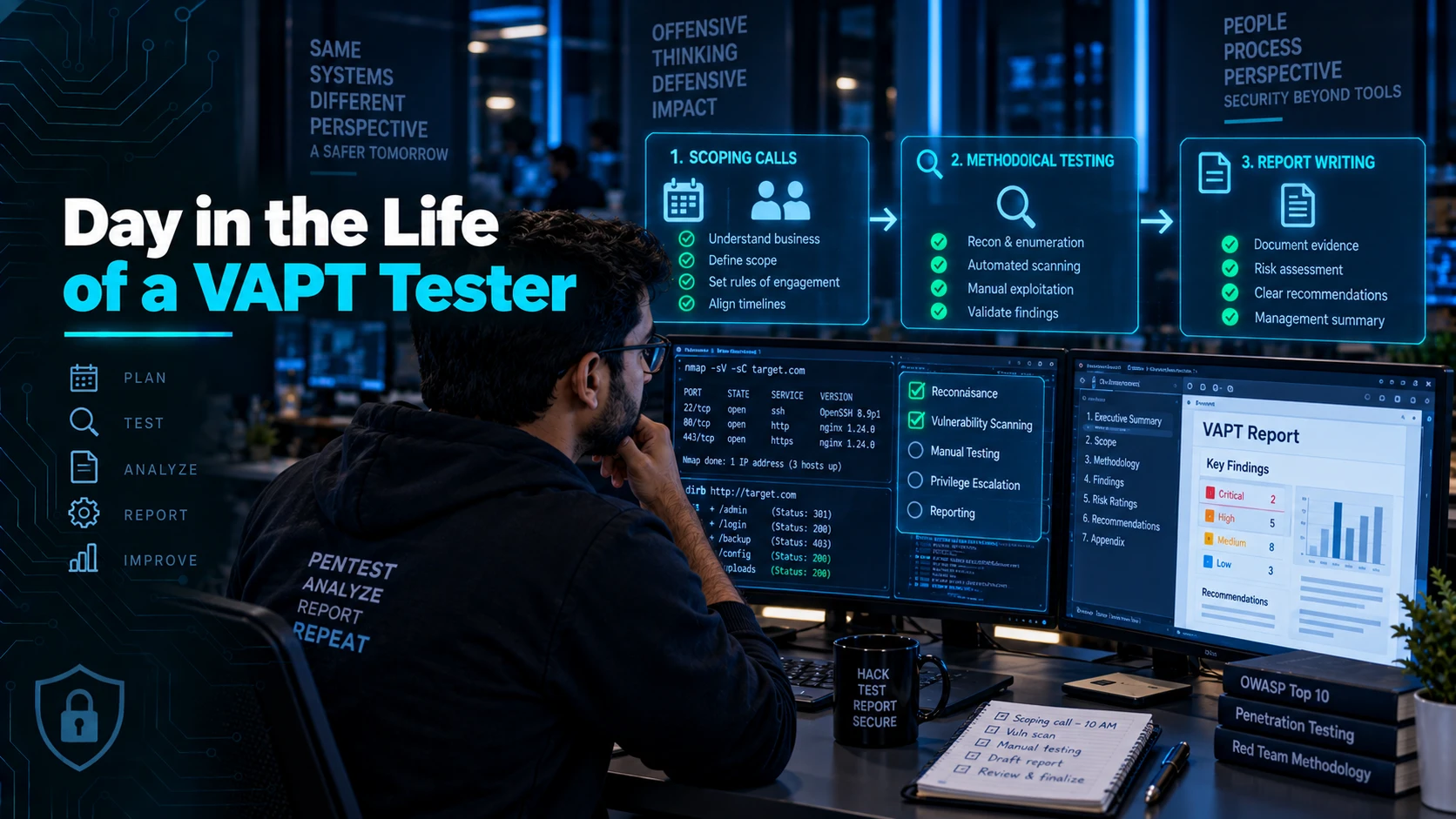
A penetration tester's actual working day looks less like a movie hacking montage and more like careful, methodical documentation work built around a fixed testing scope.

In Simple Terms (For Beginners)
A VAPT tester (short for Vulnerability Assessment and Penetration Testing) is hired to try to break into a system the same way a real attacker would, but with permission and a report at the end instead of theft.
- Most of a tester's day is spent on scoping, methodical testing, and writing clear findings, not dramatic real-time hacking.
- A single engagement typically moves through recon, testing, and reporting phases over one to two weeks.
- Report writing quality often matters as much to a client as the technical finding itself, since it drives what actually gets fixed.
ETHICAL HACKING · September 13, 2026 · 5 min · By Hardik Patel
What does a VAPT tester's day actually involve? A typical day splits between structured testing against an agreed scope, documenting each finding with enough detail for a developer to reproduce and fix it, and communicating with the client about anything urgent found along the way — closer to careful auditing than the fast-paced hacking often shown on screen.
Morning: Scoping and Setup
Before any testing begins, a tester reviews the signed scope document again — which systems are in bounds, which are explicitly excluded, and what testing window has been agreed with the client.
This isn't a formality. Testing outside an agreed scope, even accidentally, can cause real business disruption and legal exposure for both the tester and the client.
Setup also includes configuring testing tools and environments specific to that engagement, since a web application test and a network infrastructure test use largely different toolsets.
Midday: The Actual Testing
Testing itself is iterative: try an approach, observe the response, adjust, and try again. A single vulnerability might take twenty minutes to find or four hours, and there's no way to know in advance which it'll be.
Testers document as they go rather than trying to remember everything at the end — screenshots, request and response data, and step-by-step reproduction notes for anything that looks like a genuine finding.
If something critical turns up mid-test, like an exposed admin panel or a live path to customer data, most engagements include an obligation to flag it to the client immediately rather than waiting for the final report.
Afternoon and Evening: Writing the Findings
Report writing is where a lot of the actual value gets delivered, because a finding a developer can't reproduce or understand is a finding that won't get fixed.
Each finding typically includes a plain description of the issue, the business risk it represents, exact reproduction steps, and a specific remediation recommendation rather than a generic one.
Severity ratings need justification too — a finding rated critical without a clear explanation of why tends to get argued down by a client's development team, which slows down the fix.
Key Takeaways
- Testing follows a strict, pre-agreed scope; working outside it isn't part of the job, however it's portrayed elsewhere.
- Documentation happens continuously during testing, not as an afterthought once testing wraps up.
- Clear, reproducible findings with specific remediation steps matter as much as the technical discovery itself.
Frequently Asked Questions
Q: Do VAPT testers work solo or in teams?
A: It depends on the engagement size — a small business web application test might be one tester, while a larger infrastructure engagement often involves a small team split across different testing areas.
Q: What skills matter most beyond technical hacking knowledge?
A: Written communication is underrated. A technically excellent finding that's poorly explained often doesn't get fixed, so clear, structured writing is a genuine day-to-day skill in this work.
How iTechFixr Can Help
Our VAPT engagements follow this same scoped, documented process for clients across web applications, networks, and mobile apps — with plain-language reports written for both technical teams and the business owners who need to prioritise the fixes.



Need Help With This?
Talk to Hardik directly about your organisation's cybersecurity needs — get a tailored response within 24 hours.
