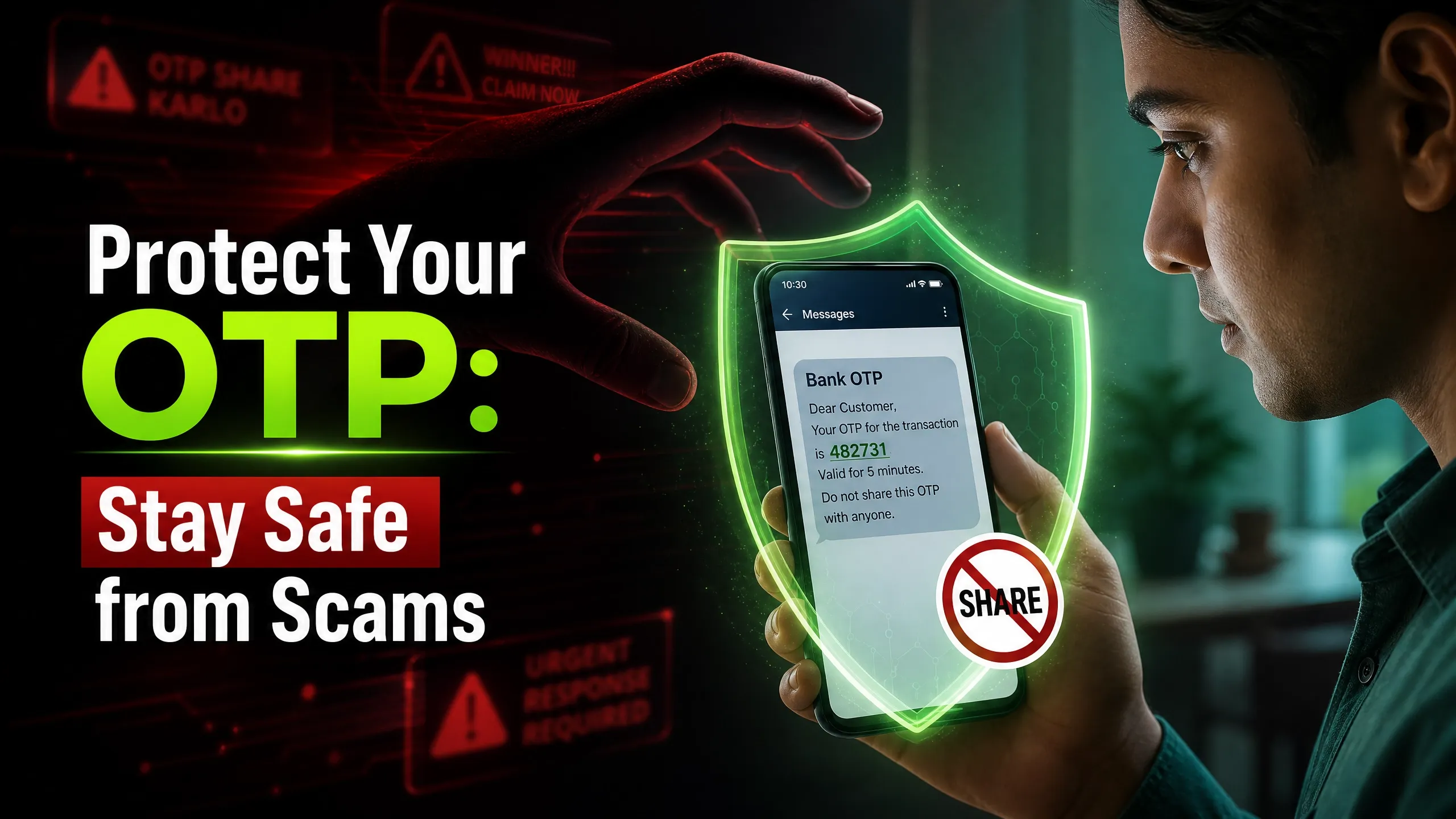
- Scammers don't hack your bank account — they get you to hand over your OTP voluntarily, often in under 60 seconds.
- The call sounds real, the urgency feels real, but no legitimate bank or government body in India will ever ask for your OTP.
- Three things you do in the next five minutes can protect your money, your UPI, and your SIM card.
Your phone rings. It's a number that looks like it belongs to your bank. The caller knows your name, your approximate account balance, and the last transaction you made. They say there's a problem with your account and they need your OTP to fix it. You have 60 seconds.
In 2025, the Indian Cyber Crime Coordination Centre (I4C) recorded over 1.1 million cybercrime complaints — a significant share involving OTP fraud. Most victims weren't careless. They were rushed.
Table of Contents
- What Is an OTP Scam and Why Do They Work So Well?
- How Scammers Get Your Personal Details Before the Call
- The Three Most Common OTP Scam Scripts in India
- What to Do When You Get a Suspicious Call
- Key Takeaways
- Frequently Asked Questions
- How iTechFixr Can Help
What Is an OTP Scam and Why Do They Work So Well?
An OTP (One-Time Password) scam is a social engineering attack where a fraudster tricks you into revealing the one-time password sent to your phone — which then lets them authorise a transaction, access your bank account, or take over your UPI ID. These scams work because they exploit urgency, authority, and the trust you already have in your bank.
The scam doesn't require any technical hacking. The attacker just needs to sound convincing for about 90 seconds. Banks and payment systems like UPI are actually quite secure — the vulnerability is human, not technical. That's why no firewall, antivirus, or software update can stop it. Only awareness can.
In the field, Hardik Patel, CEH-certified cybersecurity trainer and founder of iTechFixr Infotech LLP, Pimpri-Chinchwad, regularly encounters employees and business owners who've been victimised this way. A common pattern: the victim had used their phone number on a third-party app or entered it on an unverified website — and that data was later scraped and sold to scammers. The call felt personal because it was built on real data.
How Scammers Get Your Personal Details Before the Call
Before a fraudster calls you, they already know things about you. This is what makes the call feel legitimate and hard to dismiss.
Here's where your data typically leaks:
- Data breaches from apps and websites — food delivery apps, e-commerce platforms, and fintech apps have all experienced breaches in India. Your name, phone number, email, and sometimes partial account info ends up in hacker marketplaces.
- KYC fraud sites — fake websites offering "free SIM upgrades," "Aadhaar link verification," or "PM scheme registrations" collect your details under false pretenses.
- Social media — your name, employer, city, and even your bank (visible from tagged posts or public activity) are all intelligence for a scammer.
- Scraped data from Truecaller or similar apps — if your number is tagged as a business line, fraudsters know you're more likely to pick up.
With this data, the scammer doesn't open with "I'm calling from a random company." They open with your name, your city, and sometimes the last four digits of your card. That's the moment most people lower their guard.
If you've ever received a call where the person on the other end knew details you didn't expect a stranger to know — this post on data breach risks for Indian businesses explains exactly how that information gets compiled and sold.
The Three Most Common OTP Scam Scripts in India
Scammers in India use a small number of proven scripts. Recognising them is the first step to not reacting to them.
Script 1: The Bank Emergency Call
"Your account has been flagged for suspicious activity. To prevent it from being frozen, please verify your identity by sharing the OTP we just sent to your registered mobile number."
What's happening: The scammer has already initiated a login or transaction attempt on your bank's website. The OTP was triggered by their action, not yours. The moment you share it, the transaction goes through.
Script 2: The KYC Expiry Threat
"Your UPI/Paytm/PhonePe KYC has expired. Your account will be deactivated within 24 hours unless you complete verification. Share the OTP to confirm your identity."
What's happening: No payment app in India deactivates your account via an OTP over a phone call. This is entirely fabricated urgency. The real KYC process never involves sharing an OTP with a caller.
Script 3: The Refund/Cashback Trick
"We owe you a refund of ₹4,800 for a failed transaction. To process it, I need to send ₹1 to verify your account — please share the OTP you receive."
What's happening: The OTP you receive is for a debit, not a credit. The scammer has already set up a UPI collect request. When you share that OTP, money leaves your account — not enters it.
All three scripts have one thing in common: artificial time pressure. "Act now," "your account will be blocked in 10 minutes," "this is urgent." Urgency is the weapon. It shuts down your analytical thinking and triggers a reflex response.
For a deeper look at how social engineering works at the business level, read this post on CEO fraud and WhatsApp scams targeting Indian SMEs.
What to Do When You Get a Suspicious Call
This is the part that matters. Awareness without action is just anxiety.
Step 1: Stop. Don't share the OTP.
No matter what the caller says, hang up before sharing. The worst case if you hang up on a real bank call: you call them back and resolve it. The worst case if you share an OTP with a fraudster: your account is cleaned out.
Step 2: Call your bank directly.
Use the number printed on the back of your card or on the official bank website — not a number the caller gives you or one you find quickly via Google (which can be manipulated via ads). HDFC's customer care is 1800-202-6161. SBI is 1800-425-3800. Save these in your phone today.
Step 3: Report it.
If you've been targeted — even if no money was lost — report it to the National Cyber Crime Reporting Portal at cybercrime.gov.in or call 1930. This data helps CERT-In and I4C track and shut down fraud networks.
Step 4: Check what's exposed.
Go to haveibeenpwned.com and enter your email address. It tells you if your data has appeared in known breaches. If it has, change passwords on those platforms and enable two-factor authentication everywhere you can — using an authenticator app, not SMS where avoidable.
Step 5: Tell someone.
OTP fraud thrives on embarrassment. People don't warn their family members because they're ashamed it happened to them, or they assume older relatives won't understand. Explain it simply: "If anyone calls and asks for an OTP, they are a thief. Hang up."
At iTechFixr, when we conduct employee awareness sessions for businesses in Pimpri-Chinchwad and Pune, the most impactful moment is always this: we demonstrate a mock scam call in the room, in real time. People are shocked at how convincing it sounds — and how close they come to responding. That shock is what changes behaviour. You don't need a training room to replicate it — this post is a start. Forward it to someone who needs it. You're now part of the human firewall.
Key Takeaways
- No bank, UPI app, government body, or telecom company in India will ever ask for your OTP over a phone call. Ever. This is not a rule with exceptions.
- Scammers know your name and details before they call — that's by design, not coincidence. Real information in a fake call is still a fake call.
- The script is always the same: urgency + authority + a request for your OTP. Recognise the pattern and the call loses all its power.
- Save your bank's official toll-free number in your contacts today. When something feels wrong, you hang up and call that number.
- Reporting matters. Cybercrime.gov.in and 1930 exist for this. Use them.
Frequently Asked Questions
Q: Can a scammer do anything with just my phone number?
A: Your phone number alone gives a scammer a starting point — they can look up your name on Truecaller, attempt SIM swap fraud with your telecom provider, or target you with phishing SMS. But the real damage happens when your number is combined with other leaked data (name, city, bank) to build a convincing impersonation call. Keep your number off unverified websites and avoid entering it on unknown forms. That limits how much a scammer can build around it.
Q: I already shared an OTP — what do I do right now?
A: Call your bank immediately using the number on the back of your card. Ask them to freeze any pending transactions and flag your account. File a complaint at cybercrime.gov.in or call 1930 within the hour — faster reporting dramatically improves the chance of fund recovery. Do not wait to see if money was actually taken before acting. The moment an OTP is shared, assume the threat is active.
Q: My UPI shows no transaction — does that mean I'm safe?
A: Not necessarily. Some scams harvest credentials for later use, or use the OTP for account takeover rather than an immediate transfer. Change your UPI PIN right away via your payment app, enable transaction alerts if not already on, and monitor your linked bank account for 48 hours. If anything looks off, contact your bank and the payment app's fraud helpline.
Q: Is it safer to use an authenticator app instead of OTP by SMS?
A: For most accounts where you have the option — yes. Apps like Google Authenticator or Microsoft Authenticator generate codes locally on your phone and are not interceptable via SIM swap or call forwarding attacks. For banking in India, SMS OTP is often the only option provided, which is why call-based social engineering remains effective. Until banks offer alternatives, the best defence is simply never sharing that SMS code with anyone who calls you.
How iTechFixr Can Help
If you manage a team, running a one-hour awareness session on social engineering and OTP fraud is the highest-ROI security investment you can make — no software required. Hardik Patel and the team at iTechFixr Infotech LLP deliver these sessions for businesses across Pune and Pimpri-Chinchwad, customised to the scenarios your employees actually encounter. Book a Human Firewall workshop and turn your team into your strongest line of defence.