💡 In Simple Terms (For Beginners)
Small and medium businesses are easy targets for hackers because they often don't have dedicated security teams, use simple passwords, and don't train staff to spot fake emails or messages.
- MSMEs lose disproportionately to fraud because of how they're structured, not because staff are careless.
- Informal approval processes and multi-role staff create the exact gaps fraud is built to exploit.
- Most fixes are process changes, not technology purchases.
HUMAN FIREWALL · July 25, 2026 · 5 min read · By Hardik Patel
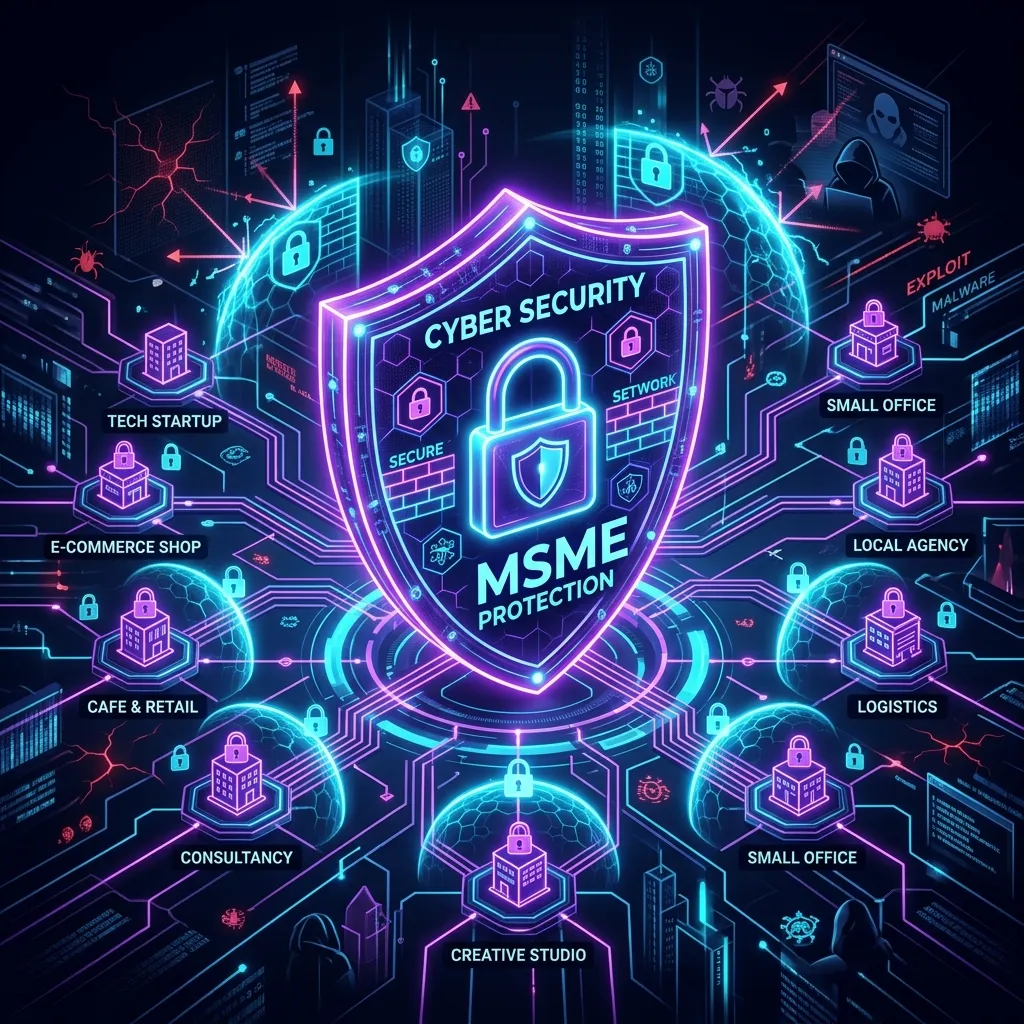
Large enterprises get the cybersecurity headlines, but a disproportionate share of real financial loss happens to small and mid-sized businesses. It isn't because MSMEs are careless — it's because of how they're structured to operate, which happens to create exactly the conditions fraud thrives on.
Table of Contents - The Structural Reasons - What This Means Practically - Key Takeaways - Frequently Asked Questions - How iTechFixr Can Help
The Structural Reasons
MSMEs are exposed less by weak technology and more by how they operate day to day — informal approvals, multi-role staff, and an assumption that fraud targets big brands, not small firms.
1. Approval processes run on relationships, not systems. In a 10–50 person company, a verbal or WhatsApp go-ahead from the owner is often enough to move money. That's efficient day-to-day — and it's the exact gap boss scams and vendor fraud are built to exploit.
2. One person often wears multiple hats. The same employee may handle purchasing, accounts, and vendor communication. Fewer people involved means fewer chances for someone else to notice something is off before a payment goes out.
3. Security is treated as a large-company problem. [Likely] Many MSME owners assume attackers target big brands with big data, not a 20-person manufacturing firm — but fraud that doesn't require breaking into a system, like impersonation and social engineering, doesn't care about company size at all.
4. Limited dedicated IT or security staff. Without someone whose job is specifically to question unusual requests, that responsibility falls informally on whoever happens to notice — which means it often doesn't get noticed at all.
5. Growth outpaces process. A business that's scaled quickly often still runs financial approvals the way it did at half the size, without the checks its current transaction volume actually needs.
What This Means Practically
None of these are technology gaps that require a large budget to fix — they're process gaps around who can approve what and how requests get verified, which is exactly why smaller businesses can close them faster than large ones once identified.
Compare this to the specific fraud patterns already covered on this blog — WhatsApp impersonation and boss scams — and the same structural weaknesses show up as the reason each one succeeds. Fixing the structure fixes exposure to all of them at once, rather than defending against each scam individually.
Key Takeaways
- MSME exposure comes from process informality, not carelessness or lack of technical investment.
- Multi-role staff and relationship-based approvals reduce the natural checks a larger organization has by default.
- Fraud that relies on social engineering doesn't care about company size, unlike fraud that requires breaching a system.
- Most fixes cost nothing beyond the discipline to apply them consistently.
Frequently Asked Questions
Q: Are small businesses really targeted as often as large ones?
A: [Likely] Not through the same methods — attackers rarely spend effort breaching an MSME's systems directly, but social engineering and impersonation fraud don't require system access at all, which makes company size largely irrelevant to those particular attacks.
Q: What's the cheapest first step an MSME can take?
A: Establishing a callback-verification rule for any payment or bank-detail change request — it costs nothing to implement and closes the single most common fraud pattern MSMEs face.
Q: Do we need a dedicated IT security person to fix this?
A: Not necessarily. Many of the highest-impact fixes are process changes — dual approval, verification rules, staff awareness — that can be implemented without hiring a full-time security role.
How iTechFixr Can Help
Need a compliance-ready risk framework? Let's map your gaps together. iTechFixr helps businesses determine their exact obligation status and builds the detection-to-reporting pipeline needed to genuinely protect your operations.