💡 In Simple Terms (For Beginners)
Scammers call you pretending to be police or custom officers, claiming a package in your name contains illegal items. They force you to stay on a video call (like Skype or WhatsApp) and tell you that you are under "digital arrest" until you transfer money to clear your name. Note: Real police never arrest anyone over video calls!
- "Digital arrest" is not a real legal process — no Indian agency arrests anyone over a video call.
- The scam works through manufactured authority, fear, and isolation, not technical hacking.
- Ending the call and verifying independently is the correct response every time.
THREAT INTEL · July 28, 2026 · 7 min read · By Hardik Patel
A call claims to be the police, escalates to video, and tells the victim they're under "digital arrest" — confined to the call, told not to contact anyone, and pressured to pay to avoid arrest. It's not real, but it has cost Indian citizens and business owners real money.
Table of Contents - How the Scam Unfolds - Why It Works - Red Flags to Recognize Immediately - What to Do If You're on One of These Calls - Key Takeaways - Frequently Asked Questions - How iTechFixr Can Help
How the Scam Unfolds
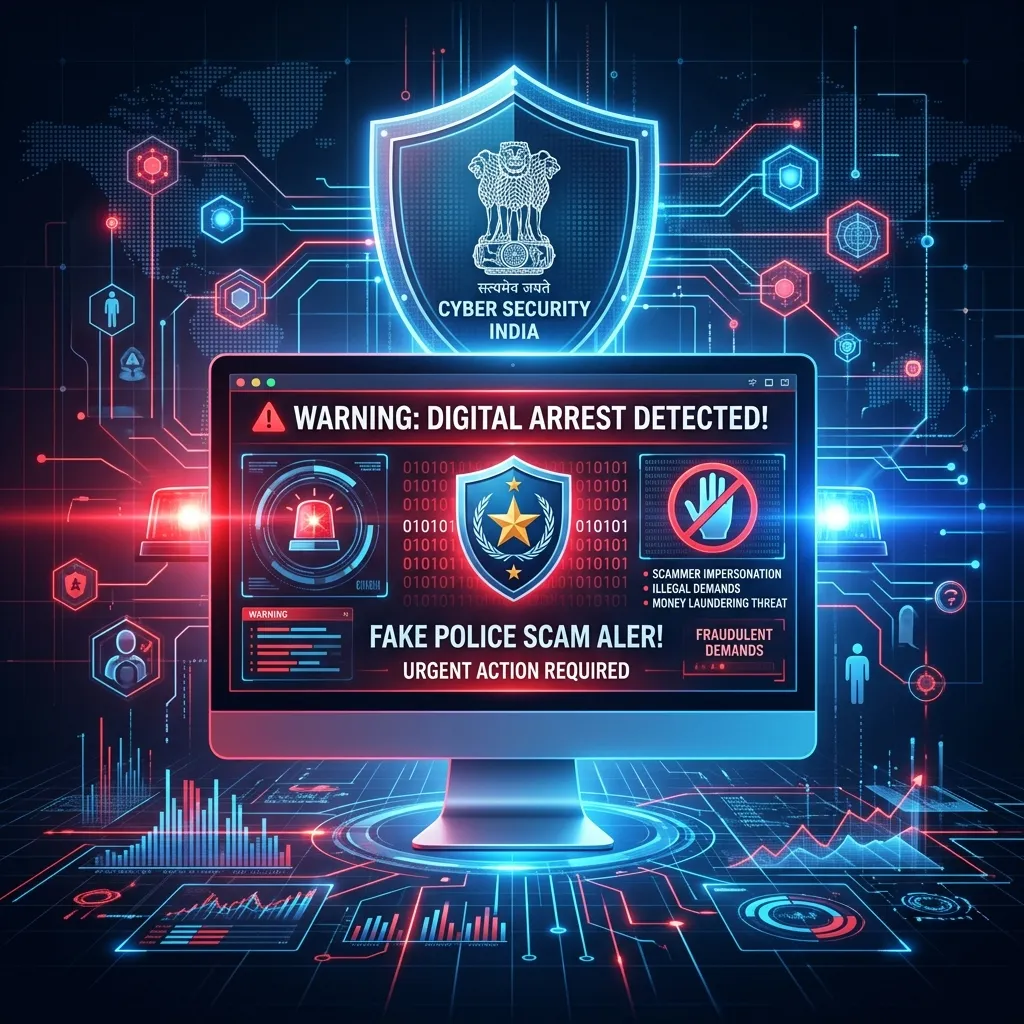
Digital arrest scams open with a call claiming to be police, customs, or a courier agency reporting an illegal package, then escalate to a video call where the victim is told they're under arrest and must pay immediately to avoid consequences.
The sequence typically runs like this: a call comes in referencing the victim's name or Aadhaar, tied to a supposed illegal shipment or investigation. The caller escalates to video, sometimes showing people in uniform on screen, and states the victim is under "digital arrest" — confined to the call and instructed not to contact anyone, including family or a lawyer. An "investigation" is described as underway, and funds are demanded immediately, often framed as a "verification" or "RBI-monitored" transfer needed to avoid formal arrest. Under sustained pressure and isolation, victims — including business owners with direct access to company funds — transfer money that is rarely recoverable once it moves.
Why It Works
The scam manufactures three things simultaneously: authority through a fake uniform and official-sounding language, fear through the threat of arrest, and isolation through instructions to stay on the call and tell no one.
[Likely] Business owners are particularly attractive targets because they typically have access to both personal savings and business funds, and the pressure tactic is specifically designed to short-circuit the instinct to pause and verify before acting — the entire scam collapses the moment a victim steps away from the call to check independently, which is exactly why isolation is enforced so aggressively.
Red Flags to Recognize Immediately
No Indian law enforcement agency conducts arrests, investigations, or identity "verifications" over video call or WhatsApp — that single fact identifies nearly every version of this scam regardless of how it's dressed up.
Watch for these markers together, not in isolation:
- A request to keep the call secret from family, colleagues, or legal counsel — this is a control tactic, not a legal requirement.
- A demand for immediate payment to "clear your name," avoid arrest, or complete a "verification" — never a legitimate government process.
- Urgency combined with isolation — real investigations do not require uninterrupted presence on a single call.
- Uniformed figures visible on a video call initiating contact rather than a formal, documented summons.
What to Do If You're on One of These Calls
End the call — you are not legally obligated to remain on it — and do not transfer any money under any framing, whether described as verification, a fine, bail, or otherwise.
If you or someone in your business receives one of these calls:
- End the call immediately, regardless of what you're told about the consequences of doing so.
- Do not transfer any money, under any description or urgency.
- Verify independently by contacting the relevant department directly through officially published numbers — never numbers given during the call itself.
- Report it to the National Cyber Crime Reporting Portal (cybercrime.gov.in) or the 1930 helpline as soon as possible.
For a related pattern that uses the same fear-and-urgency mechanism against business finance staff specifically, see our breakdown of boss scam CEO/CFO impersonation fraud.
Key Takeaways
- Digital arrest is not a legal process in India — treat any claim of it as an immediate red flag.
- The scam depends entirely on isolation; ending the call breaks it completely.
- No legitimate agency asks for payment over a call to avoid arrest.
- Reporting quickly to cybercrime.gov.in or 1930 materially improves the chance of recovering transferred funds.
Frequently Asked Questions
Q: Can Indian police really arrest someone over a video call?
A: No. Digital arrest is not a legal process. No agency in India has the authority to detain or arrest a person through a phone or video call, regardless of what is shown or claimed during the call.
Q: What should I do if I've already transferred money in one of these scams?
A: Report immediately to cybercrime.gov.in or call 1930 — early reporting significantly improves the chance of freezing the transferred funds before they can be withdrawn by the scammer.
Q: Are business owners targeted more than individuals?
A: [Guessing] Anecdotally, yes — business owners are often assumed to have access to larger, faster-movable funds, which may make them a comparatively higher-value target for this kind of pressure-based scam.
Q: Is it safe to hang up if I'm told I'll be arrested for doing so?
A: Yes. There is no legal consequence for ending a call, regardless of what the caller claims. The threat itself is part of the scam and has no legal basis.
How iTechFixr Can Help
Need a compliance-ready risk framework? Let's map your gaps together. iTechFixr helps businesses determine their exact obligation status and builds the detection-to-reporting pipeline needed to genuinely protect your operations.