💡 In Simple Terms (For Beginners)
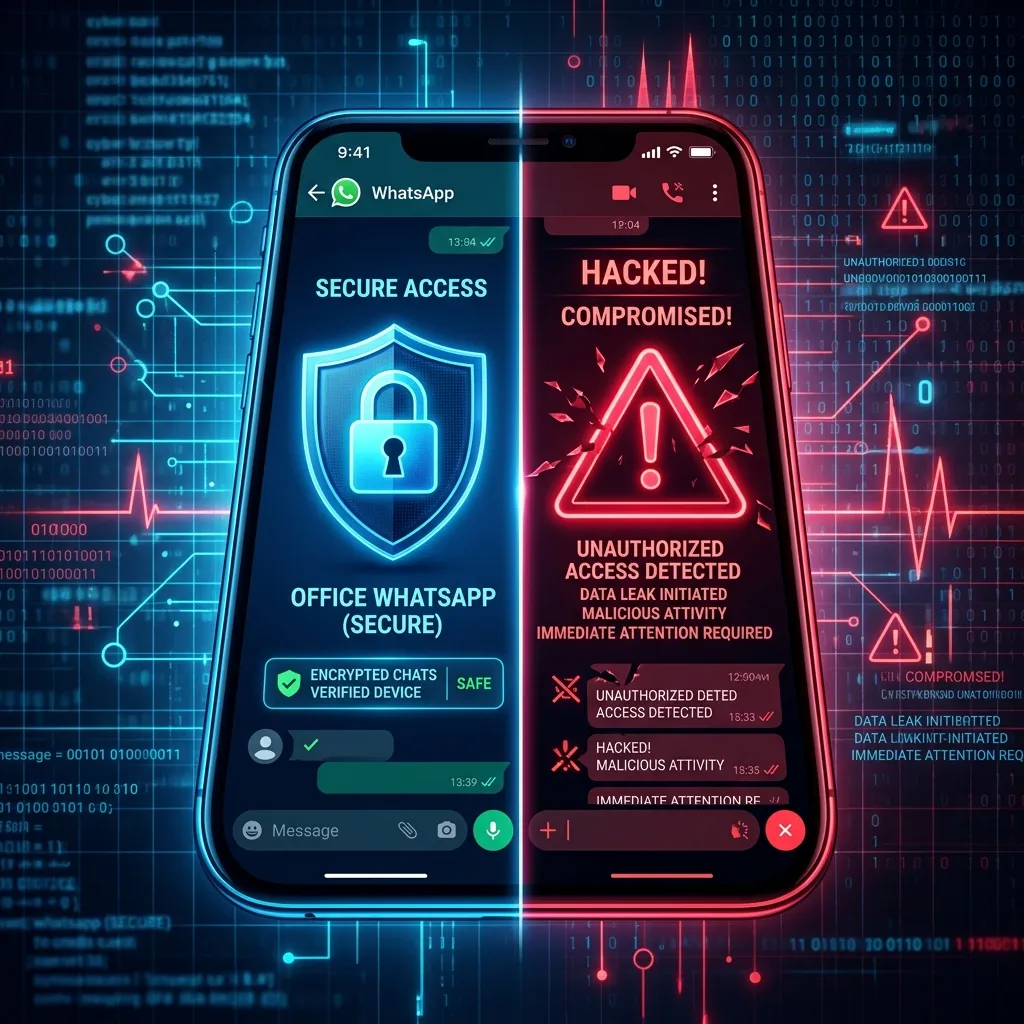
If a hacker takes over your office WhatsApp, they will message your B2B contacts and clients asking for money. If this happens, immediately warn your team, reset your registration code, and contact WhatsApp support.
- Reinstalling and re-verifying WhatsApp typically disconnects an attacker's session immediately.
- Two-step verification prevents the same takeover from happening again.
- Warning contacts fast matters, since hijacked accounts are often used to request payments.
CYBERSECURITY TIPS · August 6, 2026 · 6 min read · By Hardik Patel
The first sign is usually someone else — a client, vendor, or colleague — asking why you sent a strange message or payment request. By the time you notice, the account may already be sending fraudulent messages to your entire contact list under your company's name.
Table of Contents - Immediate Steps - How These Accounts Typically Get Hacked - Preventing It Going Forward - Key Takeaways - Frequently Asked Questions - How iTechFixr Can Help
Immediate Steps
Reinstalling WhatsApp and re-verifying your number typically disconnects an attacker's session immediately, since WhatsApp only allows one active primary session per number.
- Try to regain control first. Open WhatsApp and attempt to log in. If you're logged out or the number is no longer verifying to your device, the account has likely been taken over using your verification code.
- Reinstall and re-verify. Reinstalling WhatsApp and re-verifying with your phone number will often disconnect the attacker's session, since WhatsApp only allows one active primary session per number at a time.
- Enable two-step verification immediately. Once you've regained access, turn on two-step verification (Settings → Account → Two-step verification) so a PIN is required for any future re-registration of your number.
- Warn your contacts without delay. Send a message to your business contacts, ideally through a separate channel (email, a call, or a company announcement), confirming the account was compromised and that any recent unusual requests should be ignored and verified independently.
- Check what was sent while compromised. Review recent chats for anything sent in your name — particularly to clients, vendors, or finance contacts — since attackers often use hijacked business accounts specifically to request payments from trusted contacts.
- Report the incident. File a report with the National Cyber Crime Reporting Portal (cybercrime.gov.in) or the 1930 helpline, especially if any financial requests were sent from the compromised account.
How These Accounts Typically Get Hacked
[Likely] The most common method is a scammer tricking someone into forwarding a WhatsApp verification code — often disguised as a "wrong number, please forward this OTP" message — rather than any technical breach of WhatsApp itself.
This is worth understanding precisely because it means the fix is behavioral, not technical: no software update prevents someone from forwarding a code they were tricked into sharing.
Preventing It Going Forward
Never sharing a WhatsApp verification code, enabling two-step verification proactively, and limiting who has access to shared office accounts prevents the vast majority of these takeovers before they happen.
- Never share a WhatsApp verification code with anyone, regardless of the reason given for the request.
- Enable two-step verification on every business WhatsApp account before an incident, not after one has already occurred.
- Limit how many people have physical or session access to shared office WhatsApp accounts.
This connects directly to the same discipline covered in our post on stopping WhatsApp Web abuse in office systems — account and session hygiene is the common thread across both risks.
Key Takeaways
- Reinstalling and re-verifying WhatsApp usually disconnects an attacker's active session immediately.
- Two-step verification is the single strongest prevention step against future takeovers.
- Warning contacts quickly limits the damage, since hijacked accounts are often used for payment fraud.
- The typical entry point is a tricked OTP forward, not a technical breach of WhatsApp.
Frequently Asked Questions
Q: How do attackers get a WhatsApp verification code without hacking my phone?
A: Usually through social engineering — tricking someone into forwarding an OTP that was sent to their own number, often disguised as an unrelated or urgent request.
Q: Will two-step verification stop this from happening again?
A: It significantly reduces the risk, since it requires a PIN in addition to the OTP for anyone attempting to re-register your number on a new device.
Q: Should I inform clients even if I'm not sure anything fraudulent was sent?
A: Yes — a brief, proactive warning costs little and prevents a client from acting on a fraudulent message they may not yet have noticed or questioned.
How iTechFixr Can Help
Need a compliance-ready risk framework? Let's map your gaps together. iTechFixr helps businesses determine their exact obligation status and builds the detection-to-reporting pipeline needed to genuinely protect your operations.