How to Run a Tabletop Incident Response Exercise Employees Will Actually Take Seriously
A written incident response plan means little if the team responsible for it has never rehearsed it, and a well-run tabletop exercise is how gaps in that plan surface before a real incident does.

In Simple Terms (For Beginners)
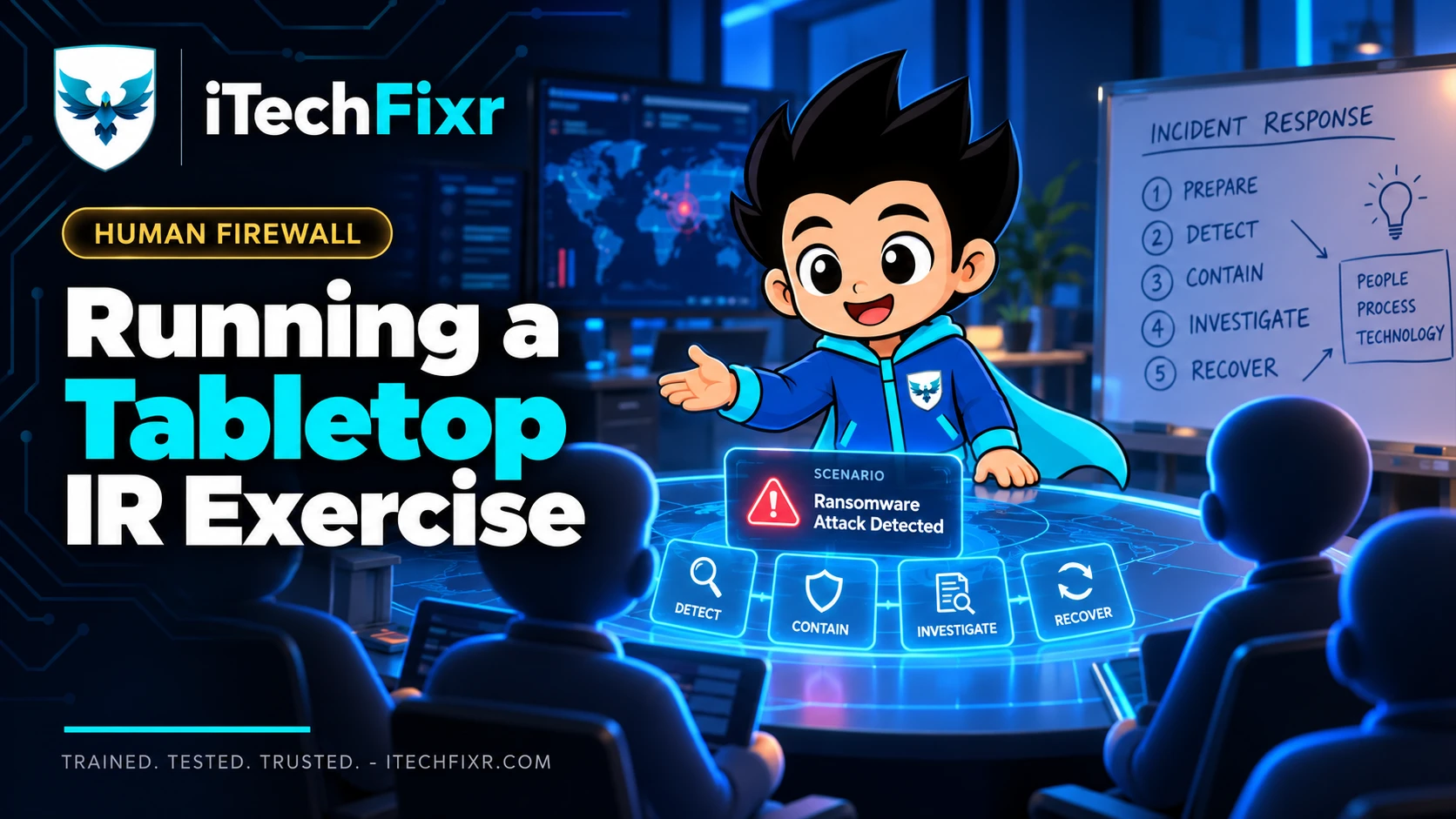
A tabletop exercise is a discussion-based drill where a team walks through a simulated security incident step by step, without touching real systems, to test whether their response plan actually works in practice.
- A tabletop exercise reveals gaps in an incident response plan that reading the document alone never surfaces.
- Keeping the scenario realistic and specific to the business, rather than generic, is what makes the exercise genuinely useful.
- Employees engage more seriously when the exercise focuses on decision-making under pressure rather than testing them for wrong answers.
HUMAN FIREWALL · October 29, 2026 · 6 min · By Hardik Patel
How do you run a tabletop incident response exercise employees will actually take seriously? Build a specific, realistic scenario tied to the business's actual systems and risks rather than a generic template, walk the team through it step by step asking what they'd genuinely do at each stage, and treat gaps the exercise reveals as valuable findings rather than individual failures to avoid discouraging honest participation.
Why Reading a Plan Isn't the Same as Testing It
An incident response plan can look complete on paper while still having gaps that only become visible when a team actually has to apply it under simulated pressure.
Common gaps a tabletop exercise reveals include unclear ownership of who makes which decision, outdated contact information for key people, and steps that assume access to a system that would actually be unavailable during a real incident.
Running the exercise costs a few hours of team time and surfaces these gaps in a low-stakes setting, which is considerably cheaper than discovering them for the first time during an actual breach.
Building a Scenario That Feels Real
A generic scenario borrowed from a template rarely engages a team the way one built around the business's actual systems, vendors, and realistic entry points does.
Good scenarios introduce a few unexpected complications partway through, the same way real incidents rarely unfold exactly as first suspected, to test whether the team can adapt rather than just follow a fixed script.
Involving people from outside IT, such as someone from customer service or finance, makes the exercise more realistic, since a genuine incident touches more of the business than the technical response alone.
Running the Exercise Without Discouraging Participation
Framing the exercise as a search for plan gaps, not a test of individual employees, keeps people willing to speak up honestly about what they'd actually do rather than what sounds impressive.
A facilitator's job is mainly to keep the scenario moving and ask what happens next at each decision point, rather than grading answers as they come in during the session.
After the exercise, documenting specific gaps and assigning an owner and a deadline to fix each one is what turns the exercise into an actual improvement rather than a one-time discussion with no follow-through.
Key Takeaways
- A tabletop exercise reveals real gaps in an incident response plan that reading the document alone won't surface.
- Scenarios specific to the business's actual systems and realistic complications engage teams more than generic templates.
- Framing the exercise around finding plan gaps, not testing individuals, keeps participation honest and useful.
Frequently Asked Questions
Q: How often should a business run this kind of exercise?
A: Once or twice a year is a reasonable baseline for most small and mid-sized businesses, with an additional exercise after any significant change to systems, staff, or the incident response plan itself.
Q: Do we need outside help to run our first tabletop exercise?
A: Not necessarily, but an outside facilitator with incident response experience often surfaces gaps a purely internal team misses, since they're not anchored to existing assumptions about how the business normally operates.
How iTechFixr Can Help
We help businesses design and run realistic tabletop exercises tied to their actual systems and risks, then work through the specific gaps the exercise surfaces so the incident response plan improves with each run.


Need Help With This?
Talk to Hardik directly about your organisation's cybersecurity needs — get a tailored response within 24 hours.
